

patriotism and nationhood
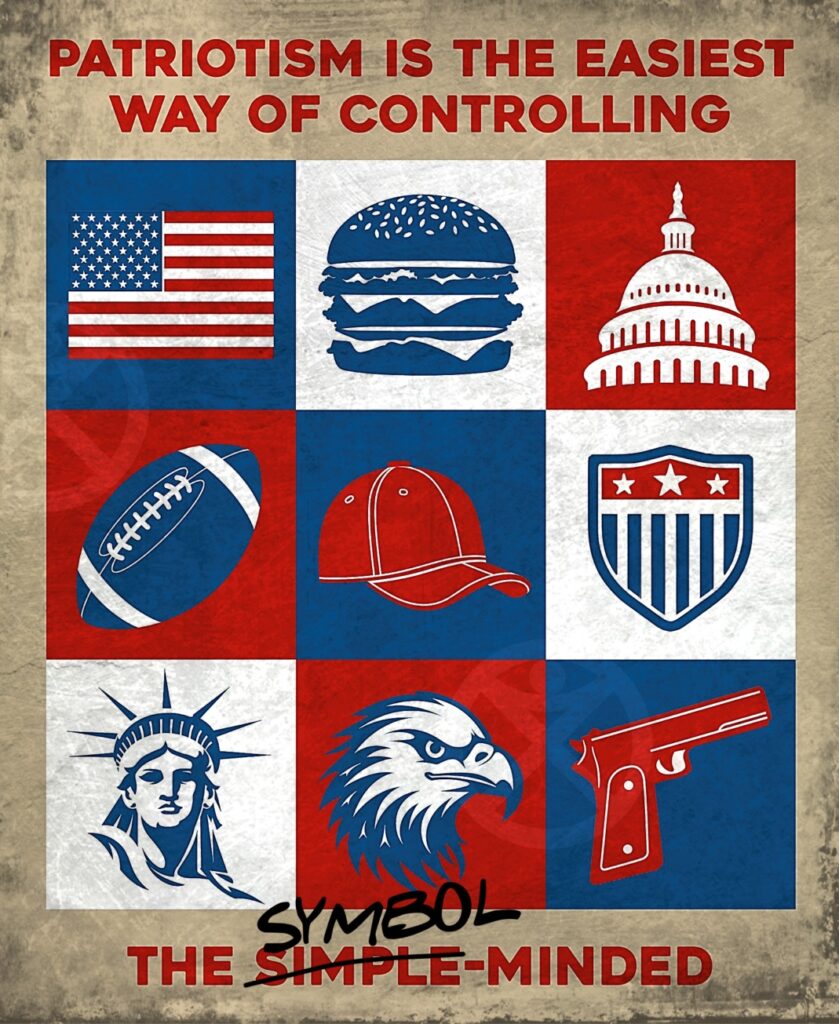
Throughout humans’ short ‘civilised era’, racism has been used both as a device to subjugate, exploit, and exclude certain people, and as a justification for war and genocide. Today, racism tries to hide discretely under the banner of nationalism: “I’m not a racist, I’m just proud of my country.” Built on a learnt suspicion of outsiders, and a resentment towards immigrants and asylum seekers, nationalism is a retreat into the assumed symbols of one’s ‘cultural identity’.
From the Stars & Stripes, and the Union Jack, to the Tricolore, national flags have become the representation of ‘cultivated’ differences, designed to undermine our common humanity. The story is the same everywhere, a fear that the familiar is being eroded by the arrival of others; their religions, their customs, their language, their exclusivity. But for those that rule – those without loyalty to any belief or nation, only power and greed – nationalism is the simplest and most enduring tool for creating divisions – divisions that we all support by giving meaning to the imposed beliefs and values that define ‘our’ culture. Religious identity carries the same destructive weight as nationalism, and when bound together under ‘god and country’, our liberty is extinguished, as we surrender our only life to illusions, explicitly invented to control and exploit us.
And, as with given religions, doubting is dangerous: refusing to salute, to pledge, to conform, marks one as disloyal, even a traitor. Patriotism is not optional – it is expected, and enforced through fear.
The problem with stoking up nationalistic sentiment is that it reinforces the divisions that encourage it, while believing we’re preserving ‘something’ of value. But what exactly are we pledging loyalty to when we raise a flag or declare ourselves ‘patriotic’?
A flag is a stitched piece of cloth. A nation is a line drawn on a map. Nationality is little more than an accident of birth – the coordinates of where we first happened to breathe. Yet these arbitrary markers are elevated into sacred symbols, worthy of loyalty, pride, and sacrifice. In reality, nationalism functions less as an identity and more of a shackle.
Its purpose has never been to celebrate the human community, but to define, divide, and mobilise populations simply to feed the hierarchy of power. Historically, this was its function. The modern nation-state was not born from the free association of people, but from conquest, colonialism, and the centralisation of authority. Nationalism ensures populations are grouped into obedient blocs, distinct from one another, and ready for conflict. By instilling a belief in shared values and a common heritage, leaders create a psychological bond that can be exploited when war, taxation, or sacrifice is required.
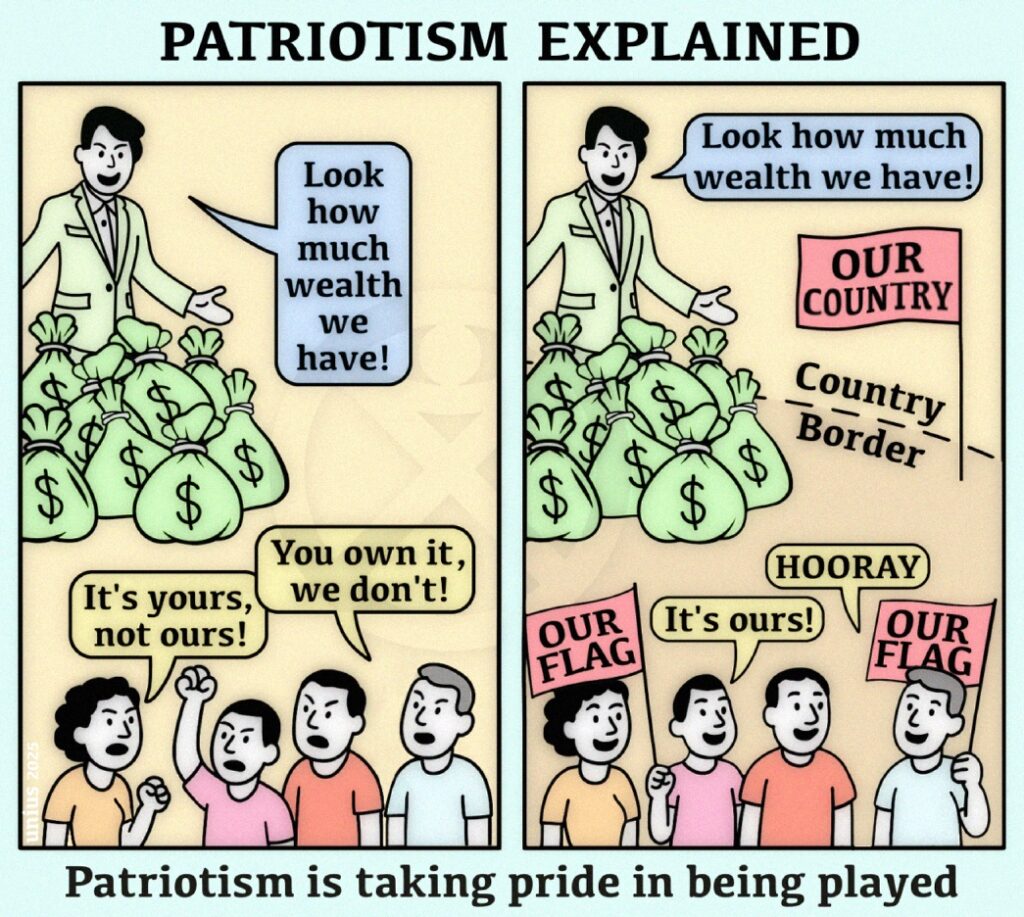
Racism has long served as nationalism’s companion. By demonising those beyond the boundary, or those within it who could be marked as ‘other’, nationalism offers the promise of purity and cohesion. Patriotism then becomes its acceptable mask: the insistence that waving a flag or pledging allegiance is somehow a noble act, when in fact it is an edict of submission and compliance, and an overt expression of racism.
The military thrives on this foundation. Nationalism creates the impression that to kill and die in uniform is not murder, but honour. Wars require narratives of ‘us and them’, ‘good versus evil’, and nationalism provides the simplest formula for both. Even economics yields to its objectives. National interest is used to justify exploitation abroad and austerity at home. The plundering of resources in far-off lands, the closing of borders to desperate migrants, and the sacrifices expected of ordinary citizens are all framed as necessary for ‘our’ prosperity – even though the benefits flow upwards to the elites who pull the strings.
Nationalism is often mistaken as a natural expression of tribalism, but in truth it is far more retrograde. Our ancestors’ tribes were rooted in reciprocity, egalitarianism, and in survival through cooperation. Nationalism, by contrast, erodes empathy. It demands that we view neighbours with suspicion, strangers as threats, and humanity itself as secondary to those arbitrary lines on a map. It is not a survival strategy, but one of self-destruction – a mechanism for leaders to exploit populations for short-term gain, at immense long-term cost.
The tragedy is that many embrace nationalism as belonging, a sense of ‘home’ in a fragmented world. But belonging built on exclusion is fragile, and pride tethered to violence is volatile. If humanity is to survive the crises it now faces – ecological collapse, displacement, inequality – it must outgrow this contrived idea of loyalty.
What is most striking is how little substance nationalism requires. Normally, claims of loyalty or entitlement are earned: we reward contribution, we value achievement. But nationalism demands nothing but our ignorance. To be nationalistic is to claim hostility as a right – the right to hate, to exclude, to draw lines between ‘us’ and ‘them’ – without any grounding beyond accident of birth. It is pride without justification, aggression without cause.
Flags will fade, nations will shift, borders will blur. But what remains a constant is our interdependence as human beings. The real challenge is not to defend the place where we happened to be born, but to defend the possibility of a future that belongs to all.

Patriotism, then, is not the virtue it is sold as. It is a thin veneer that hides a deeper servitude, the soft power that prepares us for hard violence. Its function is not to elevate us, but to distract us from asking who really benefits from our loyalty. For all the pageantry of national identity, the truth is brutally simple: nationalism keeps us divided, exploitable, and ready to kill on command.
The question we must ask is not whether we are proud of our country – right or wrong – but whether we should even support the idea of nationhood itself. If we do not see nationalism for what it is – a retrograde, destructive contrivance – we will continue to mistake our surrendered liberty for ‘belonging’, and war for ‘loyalty’.
Jan 2025
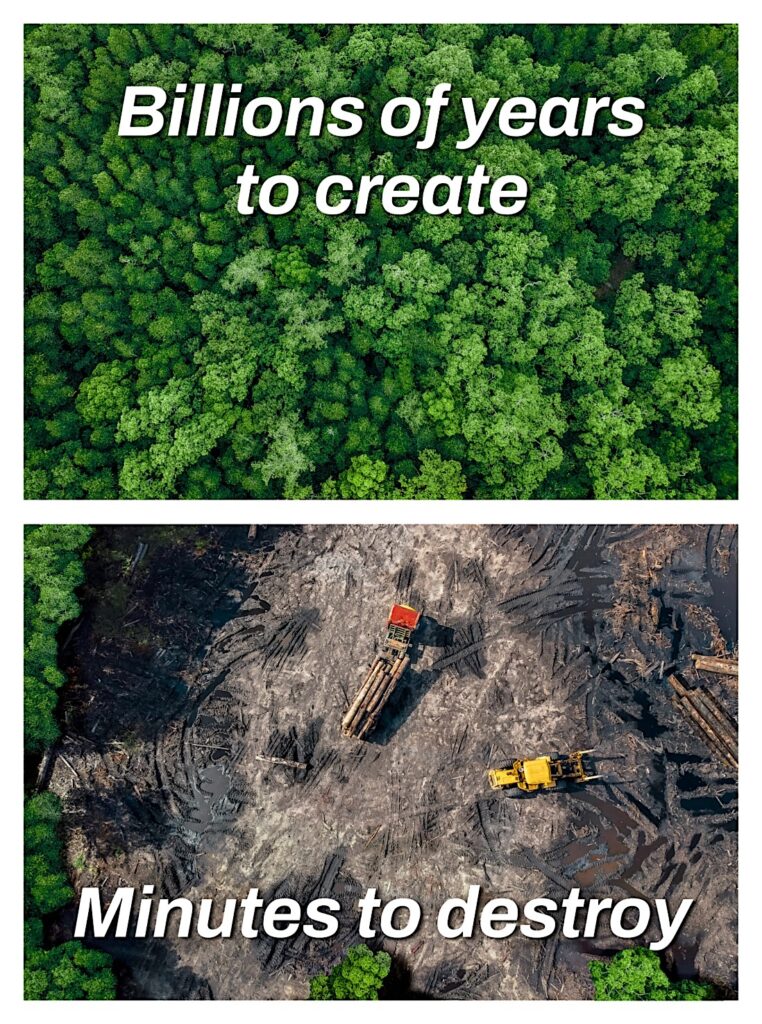
Patriotism invokes the sentiment of “this is our country”, a claim that suggests the proceeds of a nation’s resources also belong to its people. Yet that is rarely the case. Whether it’s oil fields, minerals, or agribusiness, the profits are stolen by private interests, while the citizens are left with little more than the debris of extraction.
When Brazil’s former president Jair Bolsonaro promoted the burning of the Amazon Rainforest, he claimed it belonged to the Brazilian people and could therefore be used as they wished to achieve prosperity. But the promise of prosperity was never intended for the poor. The land cleared primarily for the production of beef, only enriched the corporations, not the Brazilian people, nor the indigenous communities displaced by the flames. In 2022 alone, more than eleven thousand square kilometres of rainforest were destroyed – a rate of loss so severe that scientists now warn vast areas may never regenerate.
The idea that a national border confers the right to destroy an ecosystem essential to all life is a distortion of both morality and logic. The Amazon absorbs vast amounts of carbon dioxide, regulates global rainfall, and shelters 62% of global terrestrial vertebrate species. To treat it as a national asset to be expunged is to confuse ownership with stewardship. Rousseau’s reminder feels painfully apt: “The fruits of the earth belong to us all, the earth itself to no-one.”
Until we question the greed and ego that drive such destruction, cloaked in the language of patriotism and progress, we will continue to celebrate the burning of our own home as a victory for freedom, and watch what took billions of years to create vanish in minutes.
Jan 2025