
there is no god
“God is regarded as true by the ignorant, false by the wise, and useful by those that rule.”
Seneca, 4-65 CE
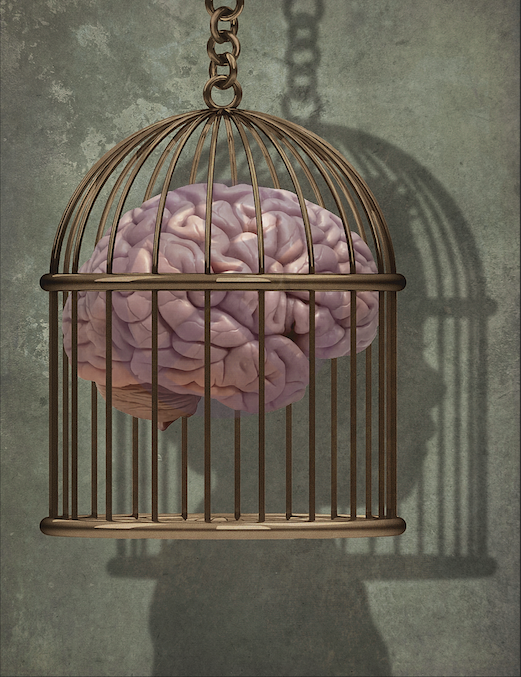
Caging innocent minds so they cannot explore or imagine, question or learn, think or create – all those wonderful gifts that allow them the liberty to become the remarkable beings that nature intended – is nothing less than abuse.
Deliberately hijacking those minds – demanding that they live within the oppressive walls of ignorant dogma, perverse traditions, and unintelligible beliefs – is criminal in it’s intent.
Convincing them that those imposed restrictions on their only life is their identity, is a manipulative lie. It is not theirs, it has been forced upon them, obliging them to perpetuate the same mistakes, injustices, and divisions that has brought all of humanity to the brink of self-destruction.
If we are to survive, we need to change, and we have to be free to do so, because submitting to the ongoing totalitarian authority of archaic religions is the most serious threat that prevents us from responding to that urgent need.
Secularists substitute a belief in god for a belief in themselves. Neither god nor the self can be defined other than in abstract and meaningless terms, because neither actually exists. Worshiping the self – that indulgent obsession with ‘me, myself, and I’ – and the pursuit of short-term, self-gratification with no regard for anyone else, or for the future, is as equally fatal for our species as believing in a god.
Until we let go of religion, stop valuing culture and tradition, and stop making ourselves slaves to an arbitrary identity, we will not be able to change.
Religion is to god, as identity is to the self
The idea of god, and of the self, served as useful explanations for creation, and for the experience of being, when our understanding of the universe, and life, was less consummate. However, it is now evident that neither are appropriate nor necessary terms to describe the mechanics that underpin what we accept as existence, both as a physical reality and as a mental interpretation. God, and that which we imagine as the ‘self’, are simply abstract inventions.
God is only made ‘real’ by religion: the architectural monuments, the traditions and customs, the ceremonies and all the paraphernalia that accompanies them, the ‘sacred’ texts and stories, the dogma, the theatre and costumes, the symbolism, the fear, the hierarchy, the patriarchy, the control, the overt lies, hypocrisy, contradictions and inconsistencies, the guilt, the bizarre promises, the praying, and of course, that trump card, blasphemy – the very real threat that faces anyone who dares to question the validity of that imposed authority – together they make up the substance of religion. Take those away, and god ceases to exist, because god is just an irrational and unexplained feature of this man-made contrivance, used to divert the truth of it’s oppressive agenda onto something that is beyond examination.
We want to fit in, and we have been encouraged to have a clear sense of identity. Religion only exists because it continues to take advantage of those vulnerabilities. Anyone fearful of questioning god need only turn to science to realise that there isn’t one there to administer any punishment – it’s only the religious authorities who do that. We are vulnerable because we are denied the opportunity to grow up and benefit from our natural potential. Religions (and other systems of hierarchy) overtly suppress our development to maintain that vulnerability so that we don’t acquire the intellect to question them, and therefore remain obedient to their authority, quietly acquiescing to those fanciful and unsubstantiated beliefs, and being preoccupied with the myriad of childish distractions they burden us with.
Our ongoing quest to find the ‘meaning of life’, is testament to our vanity, hubris and stupidity…
✦ The meaning of life, ✦
is life itself
Reducing life to something we want it to be, something outside of what it actually is, not only alienates us from ‘life’, and hence meaning, but corrupts our understanding and appreciation of it.
JoeN
The cornerstone of all monotheistic religions is that we are coerced into believing that a fantasy super-being is a real entity, one who created the universe and everything within, along with the somewhat bizarre notion that he exists in another dimension beyond this physical universe, and when we die, an intangible aspect of our bodies will magically be transported there, and will reside with him for eternity – or some variation on that theme. And we somehow justify going to war and killing one another, all because we actually believe that the version we’ve been fed is the only true one.
Standard dictionary definitions
•The real facts about a situation, event, or person.
In essence, for something to be true, it must be shown to correspond with known facts, and facts are established through evidence. Truth and fact are therefore inseparable, each an expression of the same understanding of what actually is.
Therefore, to claim that a belief is the truth is, by definition, a contradiction. The very function of belief is to afford something that lacks evidence or factual basis the appearance of validity.
When belief is elevated above truth, it ceases to describe reality and begins to invent it.
Religion exploits this deception, giving belief authority over evidence, and values conviction over understanding. Faith then becomes the mechanism by which uncertainty is transformed into certainty without justification. It requires us to accept the imagined as knowledge, and our belief as proof. But to question faith, is not to reject meaning or moral values, it is to ask whether meaning can be genuine if it’s instituted on what cannot be shown to be real.
To state something as fact without evidence, and to claim knowledge of what one does not actually know, is the definition of lying. ‘The burden of proof’ should always rest with whoever makes an assertion, and if that proof is not forthcoming, we would be foolish to accept it as true. In the real world, anyone selling a product that makes specific promises is legally required to present evidence to support those claims. The same should be expected of those selling religion.
To challenge what we are told to believe is not abandoning truth, but pursuing it, satisfying our natural desire to understand. Faith obstructs that pursuit by declaring its claims absolute. When morality is built on faith, it inherits the same fragility as belief without evidence: right and wrong become dictated by authority rather than discovered through understanding.
Morality is a feature of our shared humanity, arising from our awareness of cause and consequence. It invites empathy, compassion, reason, and care – the natural expressions of a thinking, social being. Faith, by contrast, absolves the believer from reflection, accepting morality by declaration rather than discovery. In doing so, it separates morality from truth, leaving the arrogance of self-righteousness to wander unanchored from both reality and consequence.
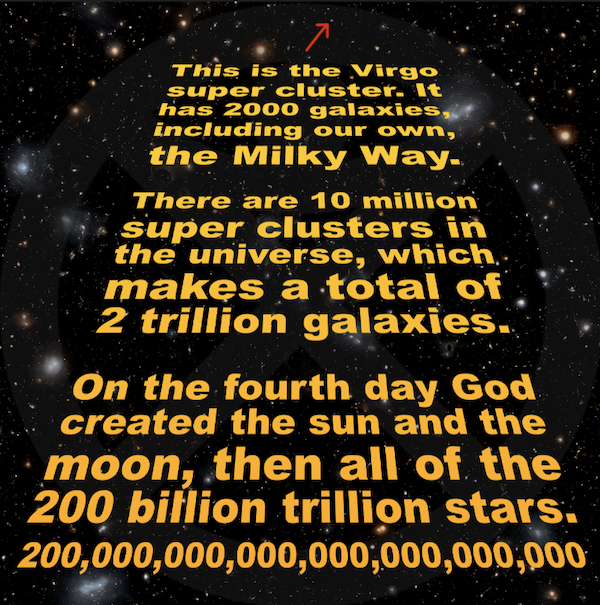
The universe: something genuinely unbelievable in it’s magnitude, where god supposedly put all life, including ourselves, on the tiniest of planets at the tail end of an insignificant galaxy, one of around 50 galaxies that are known as the local group, which together with two thousand other galaxies form the Virgo Supercluster, in a universe that is host to around 10 million of these super clusters. In total, there could be up to two trillion galaxies in the universe.
Our own planet orbits one star, the sun, out of a mere 100 billion that make up our galaxy, the Milky Way, a tiny fraction of the 200 billion trillion stars – that’s 2 with twenty-three zeros after it – which are dotted around the unimaginable expanse of the universe at large. But we won’t question the rationale behind such extremes, because god works in mysterious ways.
Religion is perhaps the oldest and most enduring form of ‘herd branding’ – demanding loyalty to self-appointed authorities who exploit faith for their own power. In return, it offers vague and unverifiable promises of love, salvation, or paradise, encouraging trust without evidence, and submission without understanding.
Sept 2023